


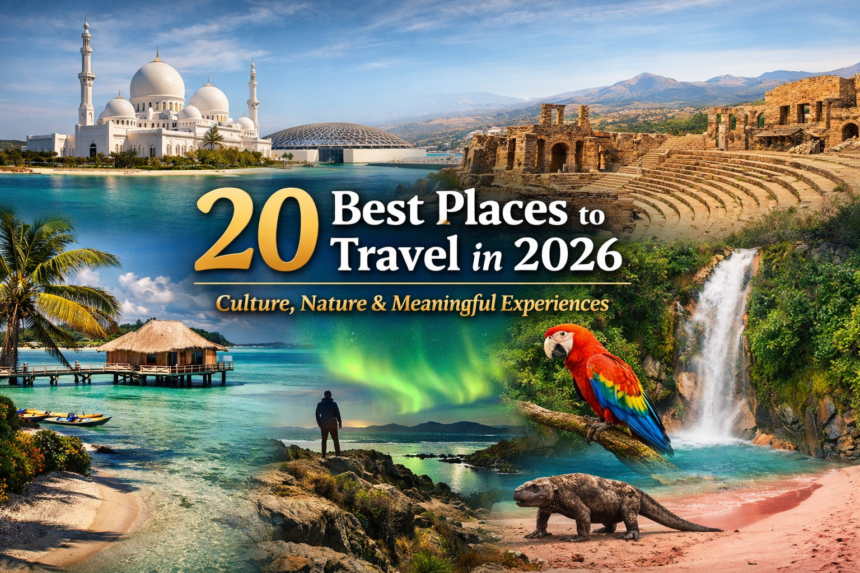
The best places to travel in 2026 reflect a new era of tourism—one driven by sustainability, culture, and meaningful connections rather than mass crowds.
This year’s most exciting destinations aren’t shouting for attention. They’re whispering, inviting curious travellers to slow down, engage, and experience something real. From Polynesian islands wrapped in luminous lagoons to Arctic cities bursting with creativity, these are the places shaping travel in 2026—not through hype, but through substance.
So, where should you go next? Let’s explore the 20 best places to travel in 2026, chosen for their culture, sustainability, and sheer ability to surprise you.
Best Places to Travel in 2026: Abu Dhabi, UAE
Abu Dhabi is having a defining moment. For years, the city quietly laid the groundwork for something big—and in 2026, that vision finally comes into focus.
At the heart of it all is the Saadiyat Cultural District, now blooming into one of the world’s most ambitious cultural hubs. Alongside the already iconic Louvre Abu Dhabi, visitors can now explore TeamLab Phenomena, the world’s largest digital art museum, where light, sound, and movement blur into immersive wonder.
The newly opened Zayed National Museum tells the story of the UAE before oil—of pearl divers, desert tribes, and the nation’s founding vision. Nearby, the Natural History Museum Abu Dhabi, inspired by regional geology, rises like sculpted sand dunes along the Gulf.
And then there’s what’s coming. The long-anticipated Guggenheim Abu Dhabi—expected late 2026 or beyond—promises to be the largest of its kind globally.
Beyond museums, Abu Dhabi is doubling down on entertainment. Yas Island continues to expand with new theme park zones, including a Harry Potter extension at Warner Bros. World and the future arrival of the Middle East’s first Disneyland.
Once a city of sand forts and fishing villages, Abu Dhabi is now a global crossroads of culture, imagination, and ambition.
Best Places to Travel in 2026 for History: Algeria
Algeria feels like one of travel’s last great secrets—and in 2026, it’s finally opening its doors.
Long known for its jaw-dropping Roman ruins, sweeping Sahara landscapes, and layered cities, Algeria has historically been difficult to visit. But that’s changing fast. Visa-on-arrival options for organised tours, new domestic airline routes, and government-backed heritage preservation efforts are transforming access.
Most journeys begin in Algiers, a coastal capital shaped by Phoenicians, Ottomans, and French colonists. Wander whitewashed streets, Ottoman palaces, and Art Deco boulevards—all within sight of the Mediterranean.
Further inland, Constantine, dramatically perched above deep gorges, offers one of North Africa’s most unforgettable cityscapes. And then there are the Roman ruins: Timgad and Djémila, sprawling, pristine, and astonishingly crowd-free.
Southward, the Algerian Sahara unfolds in endless dunes and oases. Djanet, gateway to desert exploration, feels like stepping into another world—one shaped by time, silence, and stars.
For travellers craving history without the hustle, Algeria in 2026 is pure gold.
Colchagua Valley, Chile – Wine, Horses, and Endless Skies
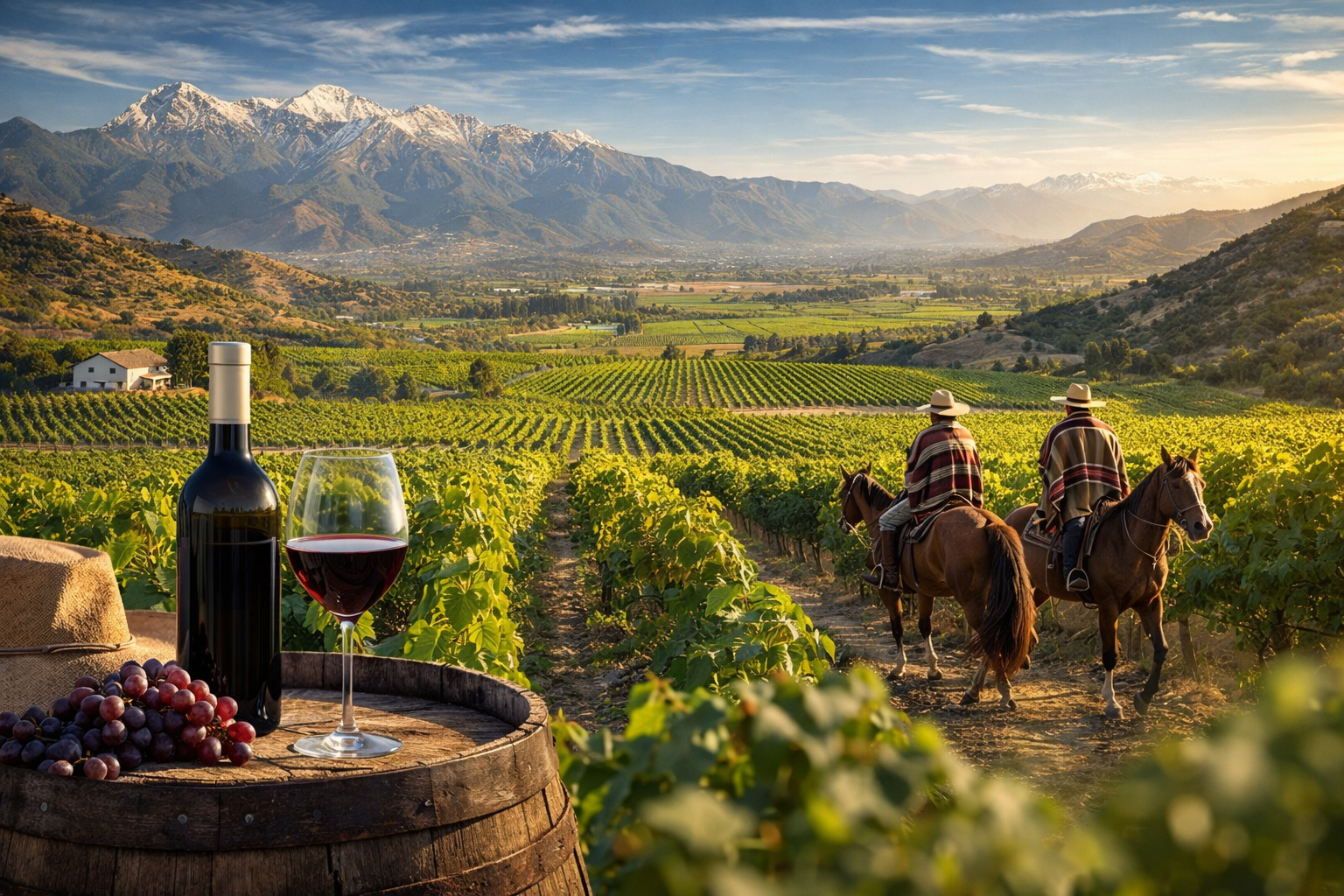
Chile’s Colchagua Valley doesn’t rush you—and that’s exactly its charm.
Stretching from the Andes to the Pacific, this fertile valley is the heart of Chile’s wine revolution. While nearby Santiago often steals the spotlight, Colchagua rewards those who venture south with vineyard-dotted hills, historic haciendas, and slow, sun-soaked days.
World-class wineries like Viu Manent, Casa Silva, and MontGras invite long tastings and longer lunches. Culinary highlights include Fuegos de Apalta, where Francis Mallmann’s fire-driven cuisine turns simple ingredients into unforgettable meals.
Stay among the vines at Clos Apalta, where modern villas seem to float above Carménère and Syrah slopes. By day, explore rodeos, adobe villages, and local markets. By night, stargaze at observatories like Cerro Chaman, where the sky feels close enough to touch.
As Chile’s original Wine Route marks its 30th anniversary, Colchagua remains a place where travellers linger—and leave reluctantly. Together, these destinations show why the best places to travel in 2026 are no longer about speed, but about slowing down and staying present.
Cook Islands – Polynesia, Pure and Personal
The Cook Islands feel like the South Pacific before mass tourism found it.
Centered around Rarotonga, a compact island ringed by turquoise lagoons and crowned with jungle-covered peaks, the nation offers everything people dream of when they imagine Polynesia—without the crowds.
Beyond Rarotonga lie 13 lesser-visited islands, many of which feel entirely untouched. In Aitutaki, the lagoon’s three newly protected motu shimmer with life, safeguarded as part of expanding conservation efforts.
Environmental leadership defines the Cook Islands’ future. Marae Moana, one of the world’s largest marine parks, continues strengthening protections, while deep-sea mining research has been delayed until at least 2032.
New air routes from Honolulu and Brisbane make access easier than ever, but the spirit remains unchanged: welcoming, communal, and deeply connected to land and sea.
Costa Rica – Where Biodiversity Meets Well-Being
Costa Rica doesn’t just protect nature—it lives it.
This small Central American nation holds nearly 2.5% of the world’s known species and has already reversed deforestation. By 2026, conservation efforts reach new heights with expanded protected areas on land and sea.
The Osa Peninsula, accessible via direct flights to Puerto Jiménez, offers rainforest-to-reef experiences that feel almost cinematic. Wake to howler monkeys, kayak glowing mangroves, surf world-class breaks, or hike deep into Corcovado National Park.
Eco-lodges, wellness retreats, and community-run surf schools combine adventure with regeneration. Here, luxury doesn’t mean excess—it means balance.
In Costa Rica, you don’t just visit nature. You become part of its protection.
The Hebrides, Scotland – Whisky, Wilderness, and Warmth
Scotland’s Hebrides feel elemental—raw landscapes softened by generous hospitality.
In Lewis, the ancient Calanais Standing Stones gain a long-awaited visitor centre, helping preserve 5,000 years of Neolithic history. On Barra, planes land on tidal beaches, and a new whisky distillery places the island on the global spirits map.
Meanwhile, Islay, already legendary for peat-heavy whiskies, welcomes two new distilleries in 2026, along with immersive experiences like the whisky-themed Ardbeg House.
Between tastings, explore white-sand beaches, medieval castles, and tight-knit communities that treat visitors like neighbours. For travellers seeking depth and purpose, the best places to travel in 2026 are those where tourism actively supports recovery and heritage.
Ishikawa, Japan – Travel That Helps Rebuild
Two years after a devastating earthquake, Japan’s Ishikawa Prefecture invites visitors not just to see—but to support.
In Kanazawa, traditional crafts thrive: gold-leaf workshops, silk dyeing, and one of Japan’s most celebrated gardens. Further north, the Noto Peninsula offers farmhouse inns where guests join seasonal farming, sustaining centuries-old rice terraces.
The region’s famed seafood, lacquerware, and sake are re-emerging thanks to community efforts like the Don’t Stop the Noto Sake initiative.
Visiting Ishikawa in 2026 means standing alongside communities rebuilding both homes and heritage.
Komodo Islands, Indonesia – Guardians of a Living Past
The Komodo Islands feel prehistoric—and that’s exactly why they matter.
Pink-sand beaches, coral reefs, and the world’s last wild Komodo dragons define this UNESCO-protected park. In 2026, its 45th anniversary brings new conservation programmes and stricter visitor management.
Direct flights to Labuan Bajo make access easier, while ranger-led treks ensure tourism funds habitat protection.
Here, adventure and responsibility walk hand in hand.
Loreto, Mexico – Conservation With a Human Face
Loreto sits quietly along the Sea of Cortez, backed by desert mountains and protected waters.
As Loreto Bay National Park nears its 30th anniversary, new conservation zones expand protection for whales, sea turtles, and mangroves. Former fishermen now serve as naturalist guides, leading kayaking and whale-watching trips that double as citizen science.
Loreto proves that conservation works best when communities lead the way.
Montenegro – Europe’s Wild Heart
Montenegro may be small, but it’s wildly diverse.
The Bay of Kotor, with its fjord-like beauty and Venetian towns, draws the crowds—but venture inland, and the country reveals its soul. Cetinje, the former royal capital, tells Montenegro’s story through monasteries and museums.
The Prokletije Mountains and Peaks of the Balkans trail offer some of Europe’s last true wilderness hikes, using sustainable tourism to revive remote villages.
At just 20 years old as a nation, Montenegro feels refreshingly untamed.
Oregon Coast, USA – Freedom by the Sea
Oregon’s entire coastline is public—and it shows.
From fog-draped lighthouses to whale-watching cliffs, this 370-mile stretch invites slow exploration. New shuttle routes, EV infrastructure, cycling paths, and accessibility initiatives make it easier than ever to explore sustainably.
Fresh seafood stays local, supporting coastal communities that have long depended on these waters.
Oulu, Finland – Arctic Creativity Unleashed
As a 2026 European Capital of Culture, Oulu transforms into a year-long celebration of art, climate awareness, and Nordic-Arctic flavours.
Expect pop-up performances, public art trails, food labs, winter cycling, island walks, and—of course—saunas. It’s a reminder that creativity thrives even in the cold. Creativity, climate awareness, and community spirit define many of the best places to travel in 2026, especially in emerging cultural capitals like Oulu.
Philadelphia, USA – 250 Years in the Making
America turns 250 in 2026, and Philadelphia takes center stage.
From neighbourhood festivals celebrating local “firsts” to global sporting events and immersive exhibitions, the city blends history with modern pride. Murals, museums, and major championships make Philly feel alive with possibility.
Phnom Penh, Cambodia – A Capital Reimagined
Phnom Penh steps confidently into 2026 with a new international airport, walkable riverfronts, electric tuk-tuks, and a creative revival rooted in sustainability.
Young Cambodian entrepreneurs are redefining the city through craft distilleries, design cafés, and restored modernist architecture—making Phnom Penh one of Southeast Asia’s most exciting urban stories.
Guimarães, Portugal – Past Meets Green Future
Portugal’s birthplace becomes Europe’s Green Capital for 2026.
Guimarães blends medieval streets with contemporary creativity, university energy, and two decades of sustainability work. Green spaces, electric transport, and adaptive reuse make it quietly revolutionary.
Conclusion
Best places to travel in 2026 aren’t chasing trends—they’re building futures. These destinations prove that tourism can preserve culture, protect nature, and strengthen communities. Ultimately, the best places to travel in 2026 aren’t defined by trends—they’re shaped by people, preservation, and purpose.
They invite us not just to visit, but to participate.
So ask yourself: where do you want your next journey to lead—not just geographically, but ethically and emotionally? In 2026, the world is wide open for travellers willing to go deeper.