


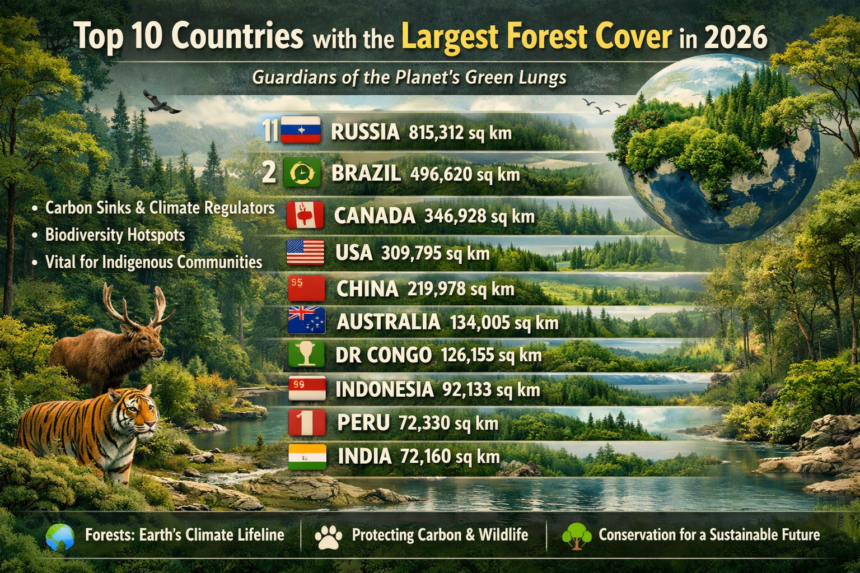
Largest forest cover countries are no longer just geography facts hidden in textbooks. In 2026, the nations with the largest forest cover have become frontline defenders in the global fight against climate change, rising carbon emissions, and ecological collapse. As wildfires intensify and ecosystems shrink, forest cover has emerged as one of the most critical environmental indicators shaping the planet’s future.
So which countries are still holding the green line?
According to recent global assessments, a handful of nations dominate the planet’s remaining forested land—not just because of their size, but because of geography, climate, and long-standing natural ecosystems. Together, these countries safeguard a massive share of Earth’s carbon sinks, wildlife habitats, and climate-regulating systems.
And yes—India makes the list.
In this deep-dive, we’ll explore the 10 countries with the largest forest cover in 2026, why their forests matter so much, and what role each plays in shaping the planet’s future. Think of it as a guided tour through Earth’s green lungs—minus the jargon and with plenty of real-world context.
So take a breath (literally), and let’s get into it.
Why Forest Cover Matters in the Largest Forest Cover Countries (2026)
Before we jump into rankings, let’s answer the obvious question: why does forest cover matter so much right now?
Forests do a lot more than look pretty. They:
- Absorb carbon dioxide and slow global warming
- Regulate rainfall and weather patterns
- Support over 80% of terrestrial biodiversity
- Protect water sources and prevent soil erosion
- Sustain millions of indigenous and forest-dependent communities
In simple terms, forests are like Earth’s life-support system. Remove them, and everything else starts to wobble.
That’s why tracking forest cover in 2026 isn’t just an environmental exercise—it’s a survival metric.
How Forest Cover Is Measured Across Largest Forest Cover Countries
Forest cover isn’t just about how green a country looks from space. It’s calculated based on:
- Total land area covered by trees
- Density and continuity of forested regions
- Natural forests versus plantations
- Climatic and ecological zones
The figures discussed here focus on total forest area, offering a snapshot of which nations still hold vast stretches of tree-covered land.
1. Russia – The Undisputed Forest Giant
Russia sits firmly at the top of the list, and frankly, no one comes close.
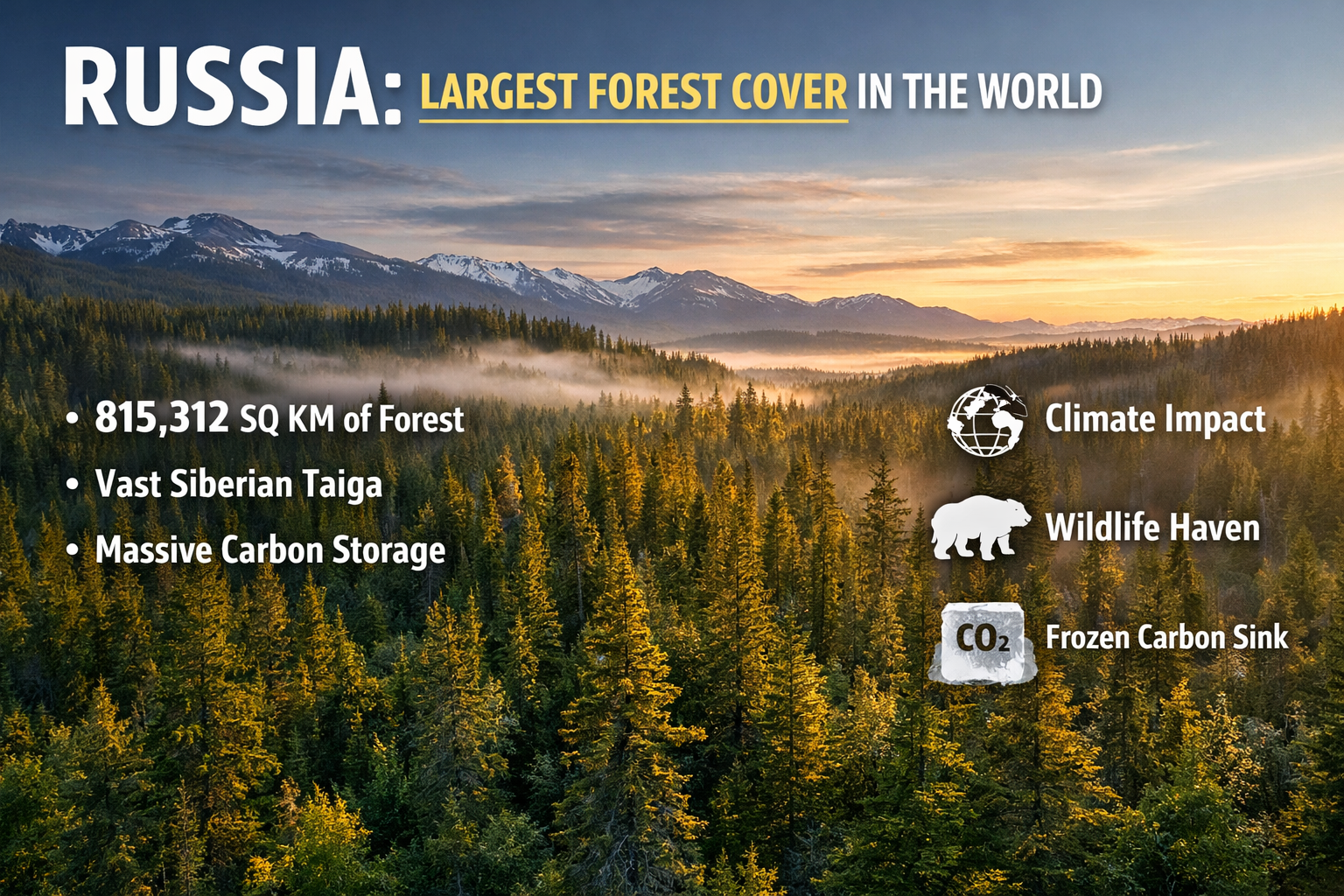
With an estimated 815,312 square kilometres of forest cover, Russia holds the largest forest area on Earth. Most of this lies in Siberia, forming the world’s largest stretch of boreal (taiga) forests.
These forests aren’t flashy rainforests filled with parrots and vines—but don’t underestimate them. Russia’s taiga stores massive amounts of carbon, both in trees and in frozen soil known as permafrost. Think of it as a giant carbon vault locked beneath snow and pine.
Despite being sparsely populated, Russia’s forests play an outsized role in:
- Global climate regulation
- Carbon storage
- Wildlife preservation
If Earth had a savings account for carbon, Russia would hold the biggest balance.
2. Brazil – Home of the Amazon Rainforest
Coming in second is Brazil, with around 496,620 square kilometres of forest cover—most of it within the legendary Amazon Rainforest.
Often called the “lungs of the planet,” the Amazon is one of the most biologically diverse regions on Earth. Millions of plant and animal species live here, many found nowhere else.
But Brazil’s forests don’t just serve South America. They influence:
- Global rainfall patterns
- Atmospheric circulation
- Carbon absorption on a planetary scale
That said, deforestation remains a serious threat. Agricultural expansion, illegal logging, and infrastructure projects continue to pressure Brazil’s forests. Still, despite these challenges, Brazil remains one of the most forest-rich nations on the planet in 2026.
3. Canada – Boreal Beauty and Wilderness
Canada claims third place with approximately 346,928 square kilometres of forest area.
Much like Russia, Canada’s forests are dominated by boreal ecosystems, stretching across vast, sparsely populated landscapes dotted with lakes, wetlands, and wildlife.
These forests are home to:
- Moose, bears, wolves, and lynx
- Indigenous communities with deep forest ties
- Critical freshwater systems
Canada’s forests act as a natural climate buffer for North America, absorbing carbon and moderating temperatures. They’re also among the most intact forest systems left—an increasingly rare quality in today’s fragmented world.
4. United States – Diverse Forests, Diverse Roles
The United States ranks fourth, with about 309,795 square kilometres of forest cover.
While the U.S. doesn’t boast a single massive forest like the Amazon or Siberian taiga, it makes up for it with remarkable diversity.
You’ll find:
- Boreal forests in Alaska
- Temperate rainforests in the Pacific Northwest
- Deciduous forests across the eastern states
These forests support wildlife, recreation, conservation, and timber industries—all while playing a key role in climate regulation.
In short, U.S. forests may be spread out, but together they pack a serious ecological punch.
5. China – A Reforestation Success Story
China holds around 219,978 square kilometres of forest cover in 2026, and what makes this impressive is how it got there.
Decades ago, rapid population growth and agricultural expansion caused significant forest loss. But China responded with some of the largest afforestation and reforestation programs in human history.
Massive tree-planting initiatives—especially in northern and western regions—have helped reclaim degraded land, reduce desertification, and rebuild forest cover.
While challenges remain, China’s progress proves that large-scale environmental recovery is possible with political will and long-term planning.
6. Australia – Forests Built for Fire
Australia comes in sixth with about 134,005 square kilometres of forested land.
Australian forests are unique. Many are dominated by eucalyptus woodlands and are naturally adapted to fire-prone conditions. In fact, some species require fire to regenerate.
However, climate change has shifted the balance. Rising temperatures and prolonged droughts have led to more intense and frequent bushfires, placing enormous stress on these ecosystems.
Despite this, Australia’s forests remain vital for:
- Biodiversity
- Carbon cycling
- Indigenous land management practices
They’re resilient—but not invincible.
7. Democratic Republic of the Congo – The Heart of Africa’s Rainforest
The Democratic Republic of the Congo (DRC) holds approximately 126,155 square kilometres of forest, making it home to the second-largest tropical rainforest in the world after the Amazon.
The Congo Basin is a true biodiversity hotspot, supporting:
- Forest elephants
- Gorillas and bonobos
- Thousands of plant species
Even more importantly, these forests act as one of the largest carbon sinks on Earth.
For millions of people, the forests aren’t just ecosystems—they’re livelihoods. That makes conservation here both an environmental and humanitarian priority.
8. Indonesia – Islands of Incredible Biodiversity
Indonesia’s forest cover measures around 92,133 square kilometres, spread across islands like Sumatra, Borneo, and Papua.
These tropical forests are some of the most biologically rich on the planet, housing endangered species such as:
- Orangutans
- Sumatran tigers
- Rare bird and plant species
However, they’re also among the most threatened. Palm oil plantations, logging, and land conversion continue to reduce forest area.
Indonesia’s challenge in 2026 is balancing economic growth with the protection of irreplaceable ecosystems.
9. Peru – Amazonian Stronghold
Peru holds about 72,330 square kilometres of forest cover, much of it within the Amazon Basin.
These forests are increasingly important for:
- Conservation tourism
- Indigenous rights
- Global climate initiatives
Peru’s forests act as a green shield for South America, storing carbon and supporting biodiversity while drawing international attention to sustainable forest management.
10. India – Forests Amid Dense Populations
Rounding out the top ten is India, with approximately 72,160 square kilometres of forest cover.
What makes India’s ranking remarkable isn’t just the number—it’s the context.
India is one of the most densely populated countries in the world, yet it maintains diverse forest ecosystems, including:
- Himalayan forests
- Central Indian sal belts
- Mangrove forests like the Sundarbans
These forests support wildlife, protect water resources, and enhance climate resilience—all while coexisting with human settlements.
India’s forests prove that conservation and population density don’t have to be mutually exclusive.
What This List Tells Us About the Future
Looking at the countries with the largest forest cover in 2026 reveals a few clear patterns:
- Large land area still matters
- Boreal and tropical forests dominate carbon storage
- Reforestation efforts can make a real difference
- Developing nations face the toughest conservation trade-offs
Forests aren’t evenly distributed, but their impact is global. What happens in Siberia, the Amazon, or the Sundarbans affects weather, climate, and ecosystems everywhere.
Conclusion
Here’s the truth we can’t ignore: forests are no longer just natural resources—they’re survival systems. The countries with the largest forest cover in 2026 are carrying a responsibility that extends far beyond their borders. These forests absorb carbon, protect biodiversity, regulate climate, and sustain millions of lives.
Think of Earth like a complex machine. Forests are the cooling system—quiet, essential, and often overlooked until something breaks. Protecting them isn’t optional anymore; it’s non-negotiable. As climate pressures grow, the value of these green giants will only increase, making conservation one of the most important investments humanity can make. Protecting the largest forest cover countries is no longer optional—it is essential for global climate stability.