

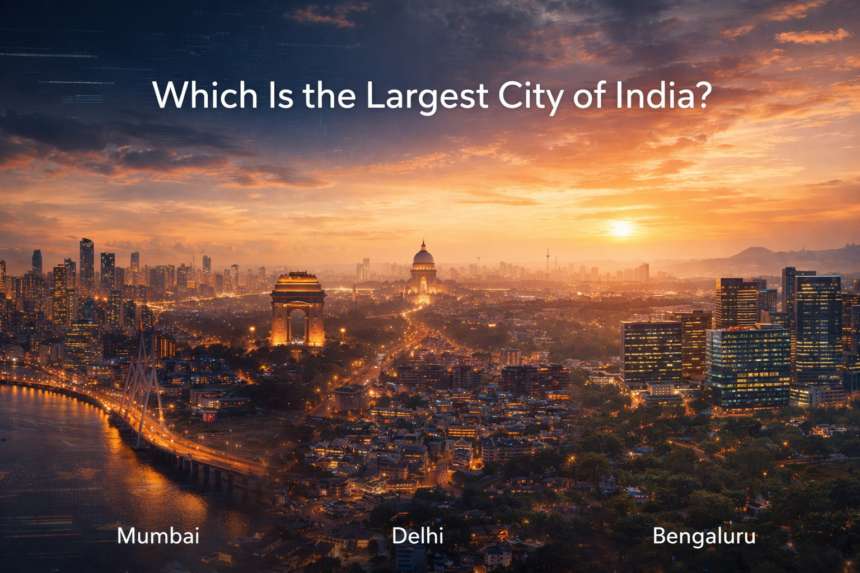
India is vast. Really vast. From crowded streets to quiet village, from deserts to coastlines, the country feel like a world of it own. So when someone asks a seemingly simple question — which is the largest city of India? — the answer isn’t as straightforward as you might think.
Is it Mumbai, with its never-sleeping spirit?
Is it Delhi, the political powerhouse?
Or could it be Bengaluru, the tech capital racing ahead?
The truth is, the answer depends on how you define “largest.” Population? Area? Urban sprawl? Metro region?
Let’s break it all down in simple terms — no confusion, no jargon — just facts, clarity, and a little storytelling along the way.
Understanding What “Largest City” Really Means
Before naming any city, we need to pause and ask an important question:
Largest in what sense?
Because cities can be “large” in different ways:
-
Population (number of people)
-
Geographical area (land size)
-
Urban agglomeration
-
Metropolitan region
Think of it like comparing houses. One house may have more people living in it, another may have more rooms, and a third may own the biggest land plot. Which one is “bigger”? It depends on what you’re measuring.
The same logic appliy to city.
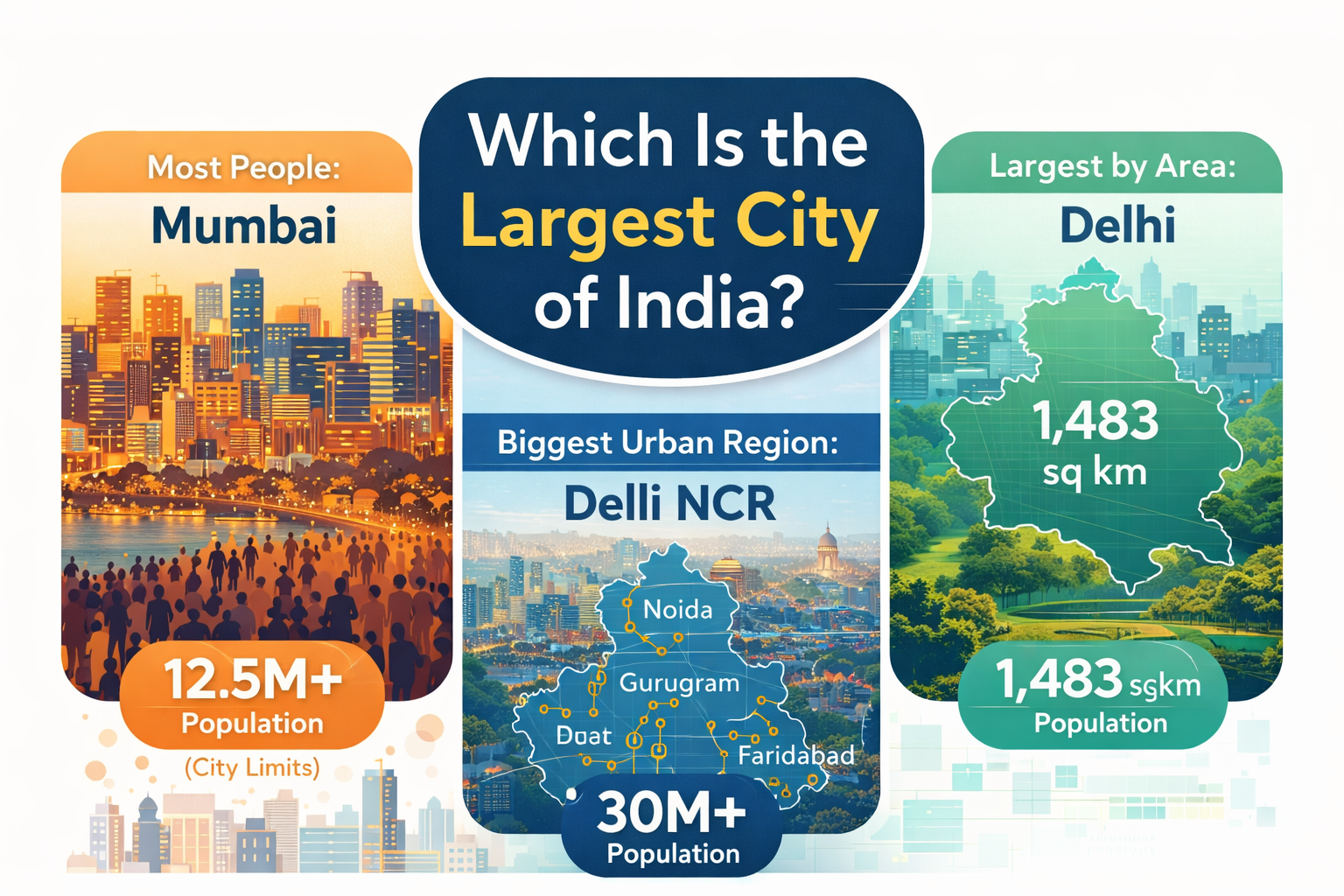
Mumbai: The Most Populous City in India
If we are talking purely about population within city limit, then the answer is clear.
| Category | Winner | Key Fact |
| Population | Mumbai | 12.5 Million+ (City Proper) |
| Total Urban Area | Delhi NCR | 32 Million+ People |
| Land Area | Delhi | 1,483 sq. km |
| Fastest Growing | Bengaluru | Silicon Valley of India |
Mumbai is the largest city in India by population.
Mumbai, the capital of Maharashtra, has an estimate population of over 12.5 million people within its municipal boundaries. That number jumps dramatically when you include the surrounding suburbs and satellite towns.
Mumbai isn’t just a city — it an emotion. From Bollywood dreams to financial ambition, million arrive here every year hoping to “make it big.”
It’s also home to:
-
India’s financial market
-
The country biggest port
-
Asia largest slum (Dharavi)
-
India most expensive real estate
In short, Mumbai wins the population crown.
Delhi: The Largest City by Urban Agglomeration
Now here where thing get interesting.
When we talk about urban agglomeration — which includes the main city plus surrounding urban area — Delhi take the lead.
Delhi is the largest city in India by urban area population.
The Delhi NCR (National Capital Region) includes:
-
New Delhi
-
Noida
-
Gurugram
-
Faridabad
-
Ghaziabad
Together, this region house over 32 million people, making it not only the largest in India but one of the largest urban area in the world.
Delhi feels less like a city and more like a network of city stitched together by highway, metro line, and history.
Bengaluru: The Fastest-Growing Giant
While Mumbai and Delhi dominate today, Bengaluru is the city everyone is watching.
Often called the Silicon Valley of India, Bengaluru has grown rapidly due to:
-
IT and tech industries
-
Startup culture
-
Global investment
With a population crossing 13 million, Bengaluru is now among India’s top three largest cities by population.
What’s unique?
Bengaluru grew not because of politics or port — but because of ideas and innovation.
It’s proof that modern citiy grow on keyboards as much as concrete.
Kolkata: Once the Largest, Still Iconic
There was a time when Kolkata was the largest city in India.
During British rule, Kolkata was:
-
The capital of British India
-
The center of trade, culture, and administration
Today, Kolkata’s population stands around 14–15 million in its metro region, making it one of the largest cities still — though growth has slowed compared to Mumbai or Bengaluru.
Yet, culturally and historically, Kolkata remain unmatched.
Chennai: The Southern Powerhouse
Chennai may not always grab headlines, but it quietly hold its place among India largest city.
With a population of over 11 million, Chennai is:
-
A major automobile hub
-
A healthcare capital
-
A strong IT and manufacturing center
Unlike some rapidly expanding cities, Chennai balances growth with tradition — modern highways next to ancient temples.
Hyderabad: The City That Reinvented Itself
Hyderabad is another strong contender among India largest city.
Once known mainly for pearl and history, Hyderabad is now:
-
A global tech hub
-
A pharmaceutical powerhouse
-
One of the fastest-growing metro region
With a population crossing 10 million, Hyderabad has reinvented itself — like an old book rewritten into a bestseller.
Pune, Ahmedabad & Surat: The Rising Challengers
While they may not top the list yet, cities like Pune, Ahmedabad, and Surat are growing fast.
Ahmedabad, for instance, is:
-
One of India fastest-growing city
-
A major industrial and business hub
-
Home to smart city initiative
Surat is among the largest city by GDP contribution, despite having a smaller population compare to metros.
Sometime, size isn’t about people — it about impact.
Largest City by Area: Which City Covers the Most Land?
If land area is your yardstick, the winner changes again.
Delhi is the largest city in India by area.
Delhi spans over 1,480 square kilometers, making it geographically larger than Mumbai, Bengaluru, or Chennai.
Mumbai, surprisingly, is much smaller in land size — which explains its dense population and sky-high property prices.
It’s like trying to fit a football stadium crowd into a classroom.
Why There Is No Single “Correct” Answer
So, which is the largest city of India?
Here’s the honest answer:
-
Mumbai → Largest by population (city proper)
-
Delhi NCR → Largest urban agglomeration
-
Delhi → Largest by area
-
Bengaluru → Fastest-growing large city
Each answer is correct — depending on the context.
It’s like asking, “Which animal is the biggest?”
An elephant is the heaviest, a giraffe is the tallest, and a whale is the longest.
All are “largest” in their own way.
How India City Are Changing Rapidly
India urban story is still being written.
Factors shaping city growth include:
-
Migration
-
Infrastructure project
-
Employment opportunities
-
Climate challenge
-
Technology and smart city planning
Cities that aren’t the largest today may become giants tomorrow.
Just 30 years ago, Bengaluru wasn’t even in the top five.
Conclusion
If you want a simple one-line answer:
Mumbai is the largest city in India by population, while Delhi NCR is the largest urban region overall.
But if you want the real answer — it’s more layer, more human, and more fascinating.
India doesn’t have one “largest” city.
It has many giant, each leading in its own way.
Cities are living organisms. They breathe, grow, struggle, and adapt. Asking which is the largest city in India is really asking how India itself is evolving.
And the beauty of it?
The answer keeps changing.